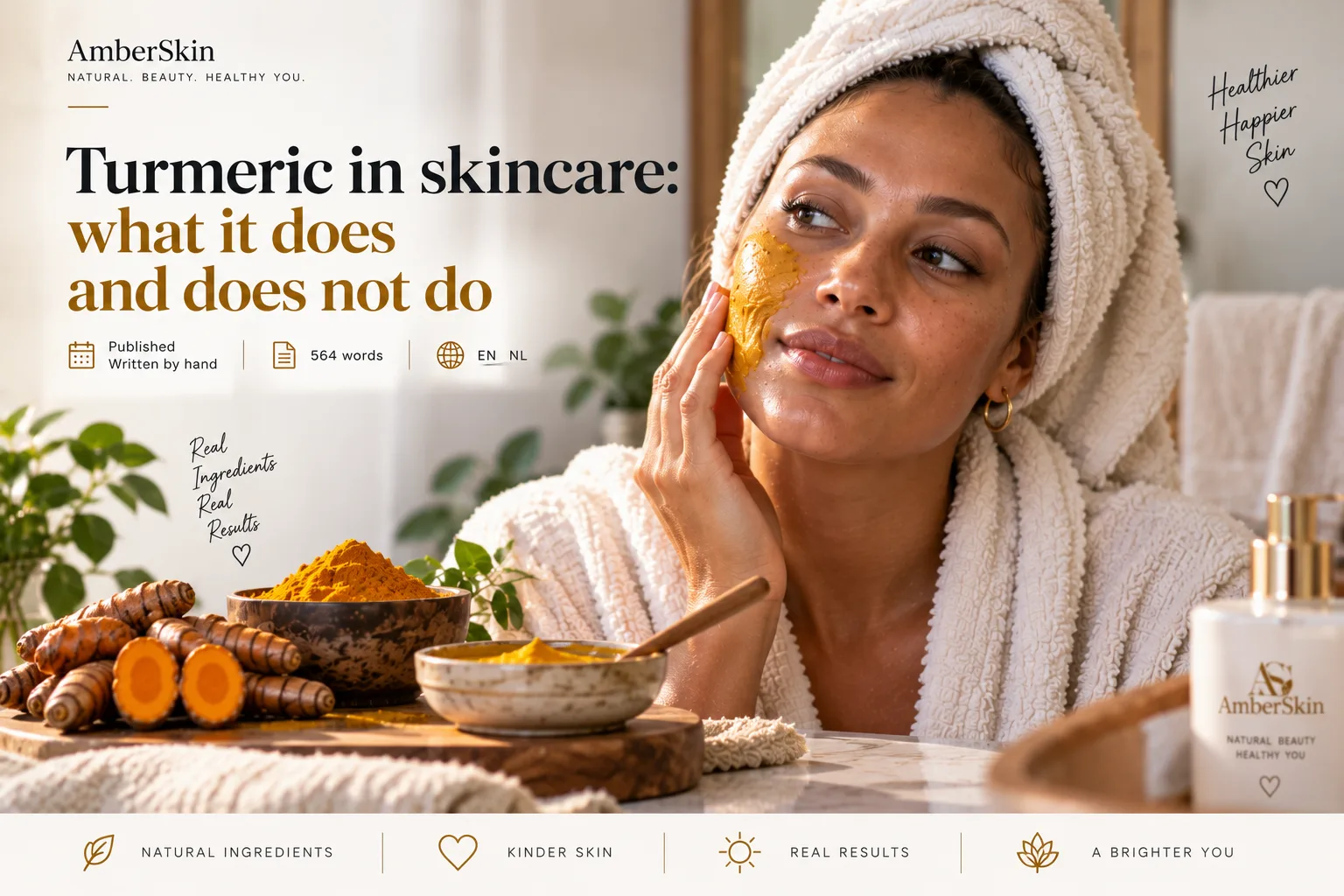
Turmeric has been part of South Asian skincare for centuries. The best-known example is the haldi, the ceremony on the morning before a wedding where the bride and groom are covered in a turmeric paste. That practice is real and it is old. What gets claimed about it afterwards very often is not.
Here is an honest account.
What turmeric plausibly does
It is an antioxidant. Curcumin, the yellow pigment in turmeric root, is a strong antioxidant in laboratory work. That is well established.
It feels calming on irritated skin. Many people experience it that way, and it is one of the reasons it is traditionally used.
It gives skin a warm glow. This is an optical effect and it is exactly what it is: how skin reflects light, not how much pigment skin produces.
What turmeric does not do
It does not lighten your skin. This is the most important point on this page.
On the wholesale market, turmeric is overwhelmingly sold as a skin lightener. We searched hundreds of listings in August 2026 and pulled two from our own shop when the label turned out to read "Super Whitening Oil" while the product title said a tidy "Brightening". Those two words look alike and mean something completely different.
- Brightening is about how skin looks: smoother, fresher, more luminous.
- Whitening is about reducing pigment.
The first is a permitted cosmetic claim in the EU. The second describes something a cosmetic product should not be doing — and if a product genuinely does it, it is no longer a cosmetic.
If you come across a turmeric product promising to make your skin lighter, that is a reason to walk away. Not because the claim is forbidden to discuss, but because a brand making it is selling you something it should not be selling.
It is not a treatment. Turmeric does not treat acne, eczema or any skin condition. Products claiming otherwise are presenting themselves as medicines.
Where the evidence is thin
Curcumin is well studied in the laboratory. On skin, in a cream, at the concentration a cosmetic product actually contains, the evidence is much thinner. Curcumin is also poorly absorbed — which is precisely why supplements add piperine to it.
So we do not tell you what turmeric "does" to your skin. We sell it for how it feels and how skin looks: a Turmeric Cleansing Oil to take the day off, a Turmeric Neck & Face Cream to finish, and a Turmeric Peel-Off Mask for the weekend. That is the whole of it, and it sits in the turmeric collection.
What you should check
An ingredient list. If a brand does not publish what is in the product, you do not know there is turmeric in it. That sounds harsh, but of the hundreds of listings we searched, almost none published an INCI list. Ours is the Turmeric & Niacinamide Cleansing Foam, and it is the only one.
Turmeric stains. A genuine turmeric product is yellow and it can colour light fabric. A brilliant white "turmeric cream" is a question mark.
No kojic acid without a percentage. Turmeric is often paired with kojic acid. That is permitted in the EU up to 1% in face products — but suppliers rarely state the concentration, and without that figure you cannot know whether it falls inside the limit.